


Key Concepts of Ar/ficial Intelligence and Risk Detec/on of Drug Use
Objectives
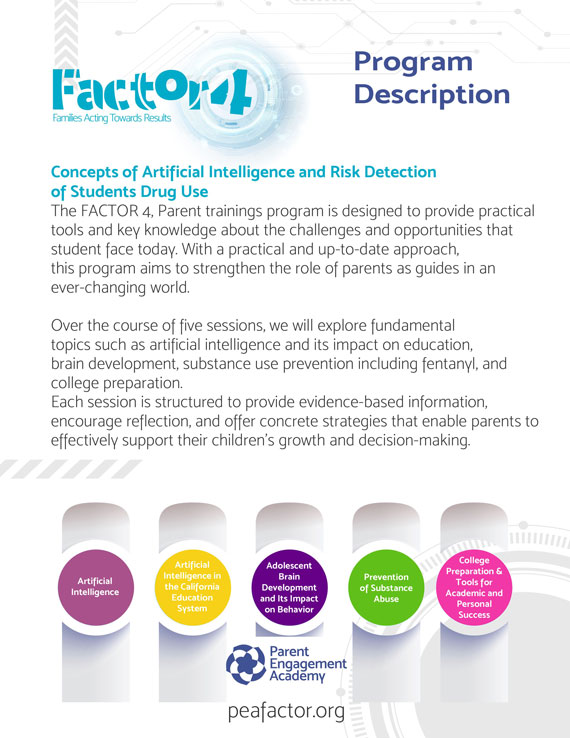
Session 1: Artificial Intelligence
1. Introduce what Artificial Intelligence (AI) is and explain the basic concepts and types of AI.
2. 3. 4. Discuss the history and evolution of AI.
Present examples of AI in daily life and in the California education system.
Explain why ethics and privacy are important when using AI tools.
Session 2: Artificial Intelligence in the California Education System
1. 2. Understand the key concepts and applications of AI in education.
Explore examples of how AI supports student learning and teaching in
California schools.
3. 4. Highlight the importance of ethical use of AI.
Reflect on the impact of AI: analyze benefits, challenges, and risks to promote a balanced perspective.
Session 3: Adolescent Brain Development and Its Impact on Behavior
1. Understand the stages of adolescence and the physical, emotional, and cognitive changes that occur during this period.
2. Recognize how the adolescent brain develops and how this influences behavior, decision-making, and emotional regulation.
3. Identify common mental health challenges, such as anxiety and depression, and learn strategies to address them.
4. Explore the impact of technology and social media.
Session 4: Prevention of use, Fentanyl and Other Substance
1. 2. 3. 4. 5. Learn what fentanyl is and why it’s highly dangerous.
Understand how drugs circulate through social media and games.
Identify emotional and social risk factors.
Detect overdose signs and strengthen family communication.
Address bullying, cyberbullying, and build resilience.
Session 5: College Preparation: Tools for Academic and Personal Success
1. Understand the concept of college readiness and its relevance in transitioning to higher education.
2. Explore key skills for academic success, such as time management,
autonomy, and decision-making.
3. Analyze the emotional and social challenges of university life and strategies to cope with them.
4. Identify available resources to support students in their academic and professional development.